
Setting A Science-Based Emissions Reduction Target
For small-to-medium sized businesses (SMEs)
Is the SME Pathway Right for Your Business?
As the impacts of climate change intensify year on year, emissions reduction is no longer a “nice to have”, but is increasingly a board-level priority. Investors, customers, regulators, and staff are all asking clearer questions about how organisations are managing climate-related risks and opportunities.
For many business leaders, the challenge isn’t whether to act – it’s how to do so credibly, affordably, and realistically.
If your organisation wants to set emissions reduction targets that are aligned with climate science, but you’re unsure where to start, you’re not alone.
This article explains what science-based targets are, how the SBTi defines an SME, and how smaller organisations can set robust, achievable targets without unnecessary complexity.
What Are Science-Based Targets?
Science-based targets are emissions reduction targets aligned with the level of decarbonisation required to limit global warming to 1.5°C, in line with the Paris Agreement.
The Science Based Targets initiative (SBTi) is the world’s leading authority for validating whether an organisation’s targets are consistent with climate science. It provides:
Sector-specific guidance (e.g. for financial institutions, FLAG sectors, energy-intensive industries)
A streamlined pathway for SMEs, designed to reduce complexity and cost
At Opportune, we use the SBTi framework to help organisations set practical, credible targets that meet stakeholder expectations while remaining realistic for their size and resources.
Why the Pathway Exists
for small-to-medium sized businesses (SMEs)
The SBTi recognises that smaller organisations face different constraints to large corporations. As a result, it offers a streamlined SME pathway designed to reduce cost and complexity while maintaining scientific integrity.
However, confusion often arises around whether a business actually qualifies as an SME under SBTi rules, and choosing the wrong pathway can result in unnecessary cost or delays.
The flow chart below provides a clear starting point.

Am I Considered an SME Under the SBTi?
You may be eligible for the SME pathway if:
Your Scope 1 and location-based Scope 2 emissions are likely below 10,000 tCO₂e, and;
You aren’t required to use a sector-specific SBTi pathway, and;
You meet at least three of the following:
a) Fewer than 250 employees
b) Turnover under NZD $101 million
c) Assets under NZD $51 million
d) You aren’t in a mandatory FLAG sector
To help clarify this further, we’ve developed a decision-tree flow chart (see below) that walks through the key eligibility questions step by step.
However, eligibility can be nuanced, particularly for businesses with parent companies or those operating in land-based sectors, which is why expert guidance is critical.
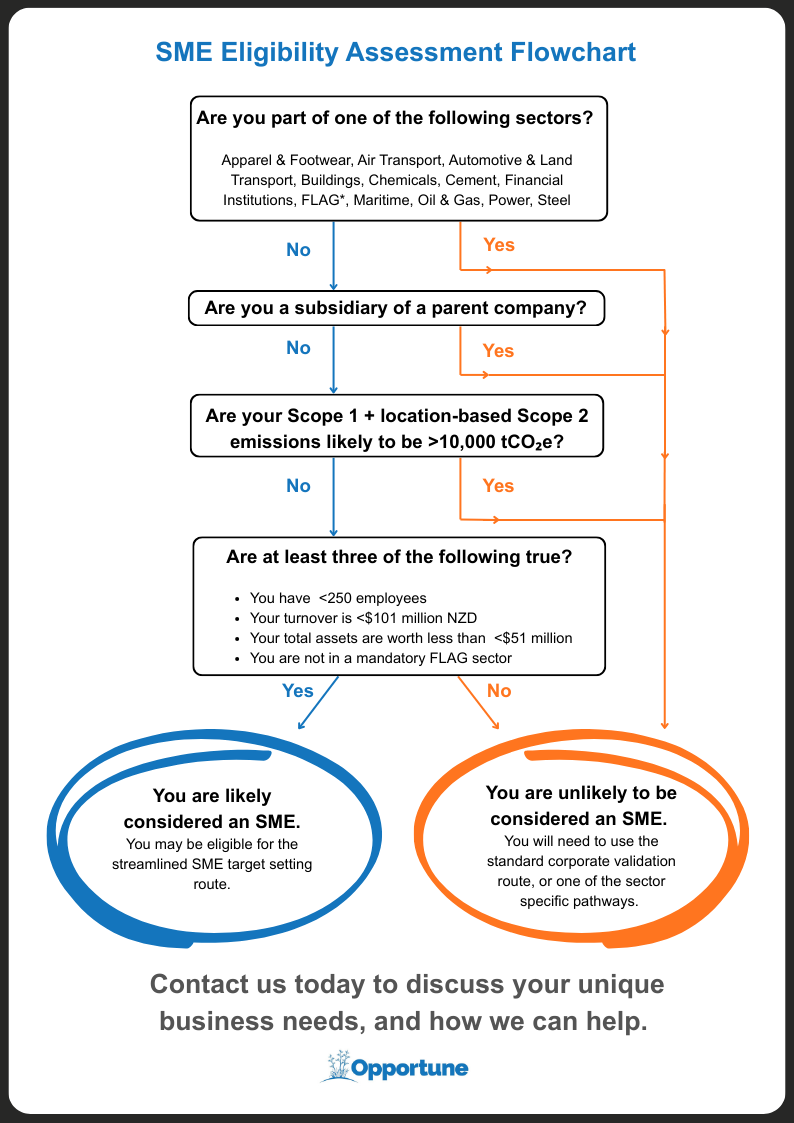
* Some smaller FLAG companies can still qualify as SMEs, provided they meet certain employee, asset and sales requirements. Contact us today if you are in the FLAG sector so we can help determine the correct SBTi pathway for you.
Key Differences of the SME Pathway
If your organisation qualifies as an SME under the SBTi, there are several important differences compared to the standard corporate route:
Scope 3 targets are not mandatory, but you must commit to measuring and reducing Scope 3 emissions over time.
Net-zero targets are optional, but you can set net-zero targets if you want to demonstrate a higher level of climate leadership & ambition. See the SBTi SME & net-zero standard guidance for details.
Optional corporate route
SMEs may still choose to use the standard corporate validation pathway if it better suits your strategy or stakeholder expectations.
This flexibility makes science-based targets far more accessible for smaller organisations.
Science-Based Target Options for SMEs
1. Near-Term Emissions Reduction Targets
Near-term targets typically cover a 5–10 year timeframe and focus on absolute reductions in Scope 1 and Scope 2 emissions.
At a minimum, targets must align with a 1.5°C pathway, which equates to:
Approximately 4.2% emissions reduction per year, or
Around 42% reduction over 10 years
SMEs must also commit to measuring and reducing Scope 3 emissions, even if formal targets are not required.
2. Long-Term (Net-Zero) Targets
Long-term targets aim for net-zero emissions by 2050 at the latest, with some organisations achieving this earlier.
To qualify as net-zero under the SBTi, SMEs must:
Reduce Scope 1, 2, and 3 emissions by at least 90%, and
Neutralise any remaining residual emissions
Common Questions We Hear from SMEs
“I’m in the FLAG sector – am I automatically excluded?”
Not necessarily. Some smaller FLAG businesses can qualify as SMEs depending on employee numbers, turnover, assets, and emissions profile. Contact us for help determining if your FLAG organisation might still be considered an SME.
“I have a parent company – can I still be an SME?”
Possibly. Eligibility depends on the size, structure, and sector of the parent entity. We can help you figure out if your business structure is considered an SME. Get in touch today.
“Can I use carbon offsets instead of reducing emissions?”
No. The SBTi requires absolute emissions reductions. Offsets may only be used to neutralise residual emissions after deep reductions have been achieved.
How We Can Help
Setting science-based targets doesn’t need to be overwhelming. At Opportune, we specialise in:
Determining which SBTi pathway is right for your organisation
Developing credible, achievable science-aligned targets
Creating practical and strategic emissions reduction plans
Aligning targets with broader climate-related disclosure and reporting expectations
Whether you are just starting your climate journey or looking to formalise your targets, we can help you navigate the process with clarity and confidence.
Get in touch today to discuss how we can help you to set emissions reduction targets and plans that work for your organisation, and for the climate.
Sources:
SBTi, Corporate Net-Zero Standard, Version 1.3, September 2025.
SBTi Services, Small and Medium-Sized Enterprises (SMEs) FAQs, Version 6.1, June 2025.
SBTi Services, Setting a target as an SME.