
How to Choose a GHG Verifier in New Zealand, before Your Board, Auditor, or Customer Asks
The demand for independently verified GHG emissions data is growing. From regulators, auditors, financiers, and customers. Choosing the right verifier matters. Here is what to look for, what to ask, and what the process actually involves.



A few years ago, independent GHG verification was a niche service. Today, it is rapidly becoming a standard expectation from investors, from large customers asking about supply chain emissions, from tender specifications, and for entities within the mandatory Climate-Related Disclosures (CRD) regime.
Yet many finance leaders and boards who need to procure this service have never done it before. They are not always sure what they are buying, what to expect from the process, or how to evaluate one provider against another. This guide addresses that gap.
First: What is GHG verification, exactly?
GHG verification (or assurance) is the process by which an independent, qualified practitioner reviews your organisation's GHG emissions inventory, which is the document that records your Scope 1, Scope 2, and, where applicable, Scope 3 emissions. The assurance provider then evaluates whether the reported information is fairly presented in accordance with a reporting standard (ISO 14064-1:2018/GHG Protocol suite) and verifies/audits the reported information, providing a formal opinion using one or more of the following standards.
That standard is typically one of the following:
ISAE 3000 (Revised): The International Standard on Assurance Engagements (Other Than Audits or Reviews of Historical Financial Information), issued by the IAASB. The overarching standard for all non-financial assurance engagements, including GHG.
ISAE 3410: Assurance Engagements on Greenhouse Gas Statements, also issued by the IAASB. Sits under ISAE 3000 and provides specific requirements for assuring GHG statements — including emissions boundaries, methodologies, emission factors, estimates, and disclosures.
ISO 14064-3: Specification with guidance for the verification and validation of GHG assertions, issued by ISO.
ISSA 5000 (upcoming): The International Standard on Sustainability Assurance, issued by the IAASB. A new standalone standard covering all sustainability information. This standard will replace the ISAE 3000 and ISAE 3410 standards, as New Zealand has adopted ISSA 5000, and it will be effective for all reporting periods beginning on or after 15 December 2026.
NZ SAE 1: Assurance Engagements over Greenhouse Gas Emissions Disclosures, issued by the XRB, which applies specifically to Climate Reporting Entities making mandatory climate-related disclosures. It requires the assurance practitioner to apply either ISAE (NZ) 3410 or ISO 14064-3 as the underlying assurance methodology.
For entities within the mandatory CRD regime, assurance must comply with NZ SAE 1. For mandated government entities within the Carbon Neutral Government Programme (CNGP) — and other organisations seeking independent assurance, engagements are typically conducted under ISAE 3000 and ISAE 3410, or under ISO 14064-3.
Limited assurance vs reasonable assurance: what is the difference?
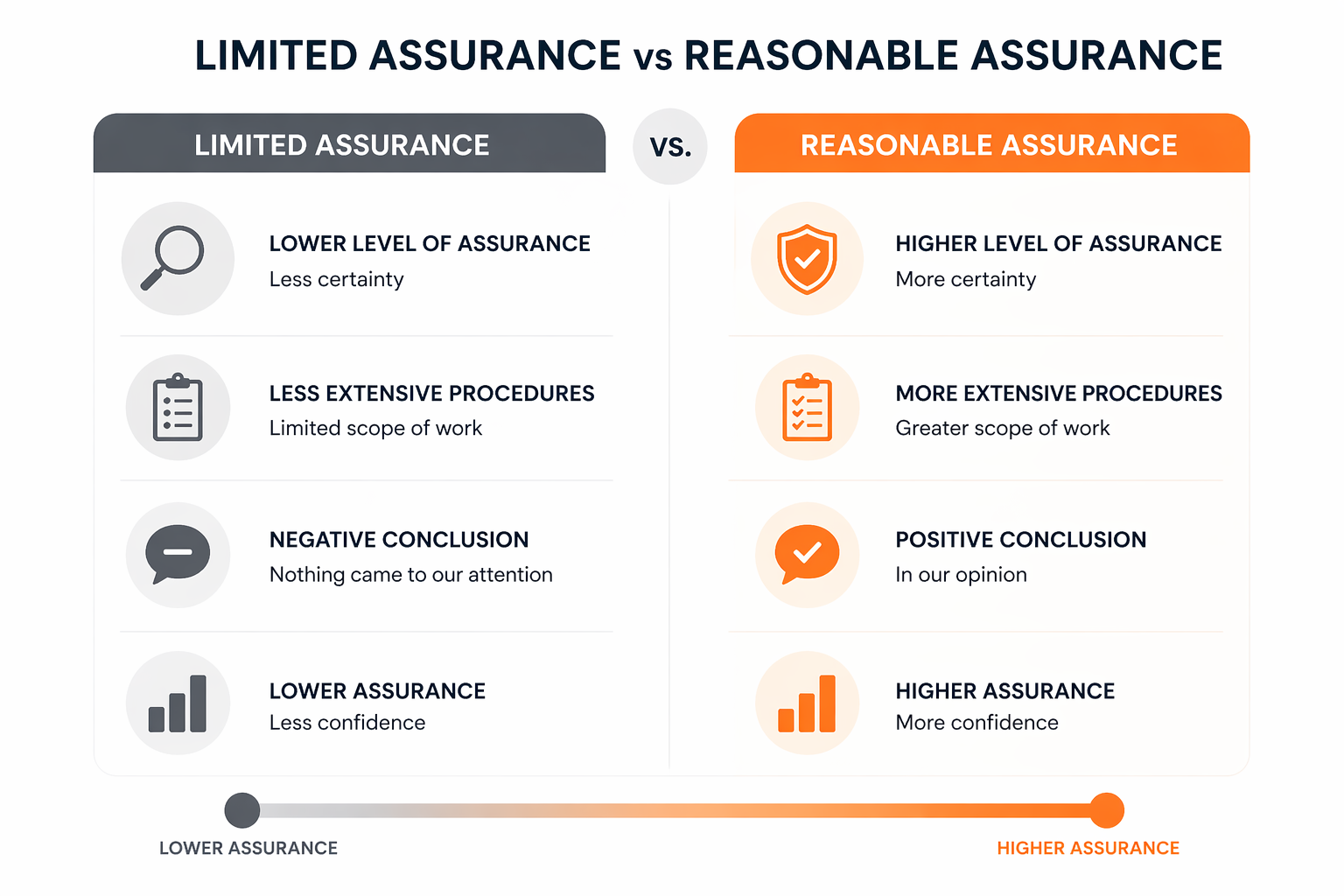
Under the mandatory CRD regime, the minimum required level is limited assurance. This is equivalent to the "negative assurance" concept in financial auditing: the verifier is providing confidence that nothing in the inventory appears to be materially misstated, based on inquiry and analytical review. The conclusion is expressed as "nothing has come to our attention..."
Reasonable assurance is a higher standard. The verifier performs more extensive evidence-gathering and substantive testing. The conclusion is expressed as a positive opinion: "in our opinion, the disclosures are fairly presented..." This standard is closer to a financial audit in terms of rigour.
Some entities choose a mixed approach. Reasonable assurance over well-established Scope 1 and 2 figures where data is robust, and limited assurance over Scope 3 where estimation is more inherent. Both levels can appear in the same assurance report.
Five questions to ask any GHG verifier before you engage
1. Are you qualified under the relevant standard?
For engagements under ISAE 3410 / ISAE 3000, the practitioner should hold appropriate professional qualifications and demonstrate competency in both assurance methodology and the underlying subject matter. Under ISSA 5000, this emphasis on subject-matter competency becomes even more explicit. For engagements under ISO 14064-3, the verifier must meet the competency requirements specified in the standard — including knowledge of GHG quantification, relevant sector activities, and verification methodology.
Ask specifically which standard applies to the engagement you need — and why.
2. What is your independence position?
A verifier who also prepared your inventory cannot provide independent assurance of it. This is not a technicality — it is a fundamental principle of assurance. The FMA has published guidance for CREs on third-party provider due diligence, which makes clear that responsibility for the accuracy of disclosures sits with the reporting entity, not the adviser. Independence must be real, not just declared.
3. What scope will you cover?
Scope 3 assurance is significantly more complex than Scope 1 and 2. Ask any potential verifier whether they have experience assuring Scope 3 categories. Particularly categories like purchased goods and services, business travel, employee commuting, investments, or financed emissions (Category 15), which require specialist methodological knowledge. If Scope 3 is material to your inventory, you need a verifier with demonstrated capability in this area.
4. What evidence do you need from us, and how long will it take?
A verification engagement typically requires access to: source data and documentation for each emission source; your methodology documentation; prior period inventories and any restatements; relevant policies and controls; and key personnel for interviews. A well-run limited assurance engagement for a straightforward Scope 1 and 2 inventory might take two to four weeks from data provision to draft report. A complex Scope 1, 2, and 3 engagement, or one under NZ SAE 1, may take longer. Getting a realistic timeline upfront prevents surprises at the end of your reporting period.
5. What happens if you find a problem?
Good verifiers find issues. A material misstatement, an inconsistent methodology, or a boundary gap may result in a modified conclusion — meaning the assurance opinion is qualified, disclaimed, or adverse. Ask how your potential verifier handles these situations, what the process is for giving you the opportunity to correct errors before a conclusion is issued, and what a modified conclusion would mean for your reporting timeline and disclosures.
Pre-engagement checklist
- The verifier is qualified under the specific standard your engagement requires (NZ SAE 1, ISAE 3410/3000, ISO 14064-3)
- The verifier has not prepared your inventory — independence is established and documented
- The scope of the engagement (which scopes, which categories, which legal entities) is agreed in writing
- The level of assurance (limited or reasonable) is specified for each part of the inventory
- Key timelines are confirmed, including when source data must be provided and when the draft report is expected
- The fee basis is clear — particularly whether it is fixed or time-and-materials, and what triggers additional fees
- You understand what evidence you need to provide and have a responsible person internally who will manage the process
- You have confirmed how modified conclusions are handled, and what your rights are before a conclusion is finalised
What the verification process actually looks like
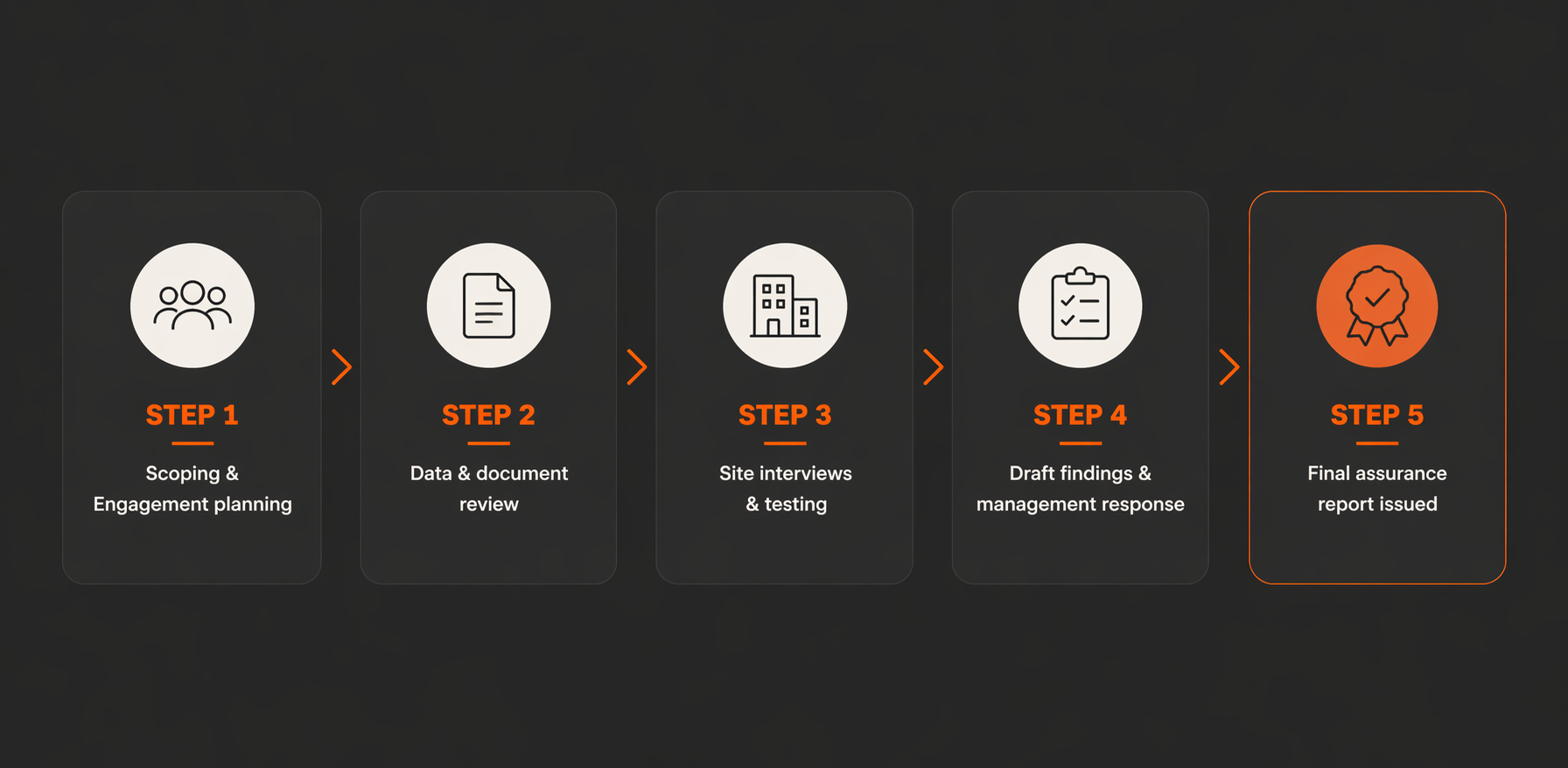
A GHG verification engagement typically moves through five stages. During the scoping stage, the verifier and client agree on the boundary, scope, materiality threshold, and level of assurance. The data review stage involves examining your emissions inventory alongside source data, emission factors used, and methodology documentation. Site visits or interviews allow the verifier to test whether the data is consistent with what is actually happening in the business. Draft findings give you the opportunity to respond to any issues before a conclusion is issued. The final report contains the formal assurance conclusion.
What information should you prepare?
The quality of your verification engagement is directly linked to the quality of what you bring to it. Organisations that have good data management and clear documentation will have smoother, faster, and less expensive engagements.
The minimum documentation you should be able to provide:
A complete emissions inventory spreadsheet or report, with calculations visible and emission factors cited
Source data for each emission category (fuel purchase records, electricity invoices, travel data, waste records, etc.)
A written methodology statement explaining how boundaries were set and which standards were followed
Any prior-period inventories and a note of any changes in methodology or boundary since last year
Access to key staff who can answer questions about data sources and operational processes
On choosing an adviser vs a verifier
Some firms offer both advisory (helping you build your inventory) and assurance (independently verifying it). If you use the same firm for both, you lose the independence that makes the assurance credible. A cleaner model is to use one firm to build and one to verify. Alternatively, some providers can assist with pre-assurance readiness work (reviewing your inventory before formal verification begins) without compromising formal assurance independence. Ask about this boundary explicitly when scoping any engagement.
The FMA's third-party provider guidance — what it means for you
The Financial Markets Authority has published guidance making clear that a Climate Reporting Entity's responsibility for the accuracy and completeness of its climate disclosures does not transfer to its third-party advisers or assurance providers. If your GHG data is wrong, that is your problem — not your verifier's.
This matters for how you think about verification. The purpose of GHG assurance is not to transfer responsibility. It is to provide independent confidence to your stakeholders — investors, lenders, customers, regulators — that what you are saying is accurate and methodologically sound. That distinction should shape how you think about data quality, governance, and internal controls around your emissions reporting, not just what you ask your verifier to sign off on.
| Engagement type | Standard | Who needs it | Status |
|---|---|---|---|
| GHG assurance — Scope 1 & 2 | NZ SAE 1 | CREs — mandatory CRD regime | Required (from Oct 2024) |
| GHG assurance — Scope 3 | NZ SAE 1 | CREs — mandatory CRD regime | Extended — check XRB adoption provisions |
| CNGP verification | ISAE 3410 / ISAE 3000 or ISO 14064-3 + CNGP programme | Public service agencies | Required (annual) |
| Voluntary inventory verification | ISAE 3410 / ISAE 3000 or ISO 14064-3 | Any organisation — private, council, NGO | Voluntary — commercially driven |
Thinking about GHG verification for the first time?
Opportune provides independent GHG verification services across the voluntary, CNGP, and CRD assurance spectrum. We are happy to explain the process, scope what you need, and give you a clear picture of what to expect without any jargon.
